Reinforcement learning · Failure analysis
Highway RL Agent: PPO and Unintended Slow-Driving Behavior
A reinforcement-learning project using PPO in simulated highway and intersection environments. The repository documents a policy that favored slow driving instead of the intended behavior.
Task and setup
The project uses Stable-Baselines3, Gymnasium and highway-env to train and evaluate PPO agents. The highway task combines forward progress with collision avoidance; the intersection task involves goal-directed navigation through cross-traffic.
Project record
The README identifies this as a reinforcement-learning final project and names Obada Alsehli as a group member. It documents the PPO setup, environment configurations, reward design and checkpoint analysis. This page describes that public record and avoids attributing unpublished work.
Reported behavior
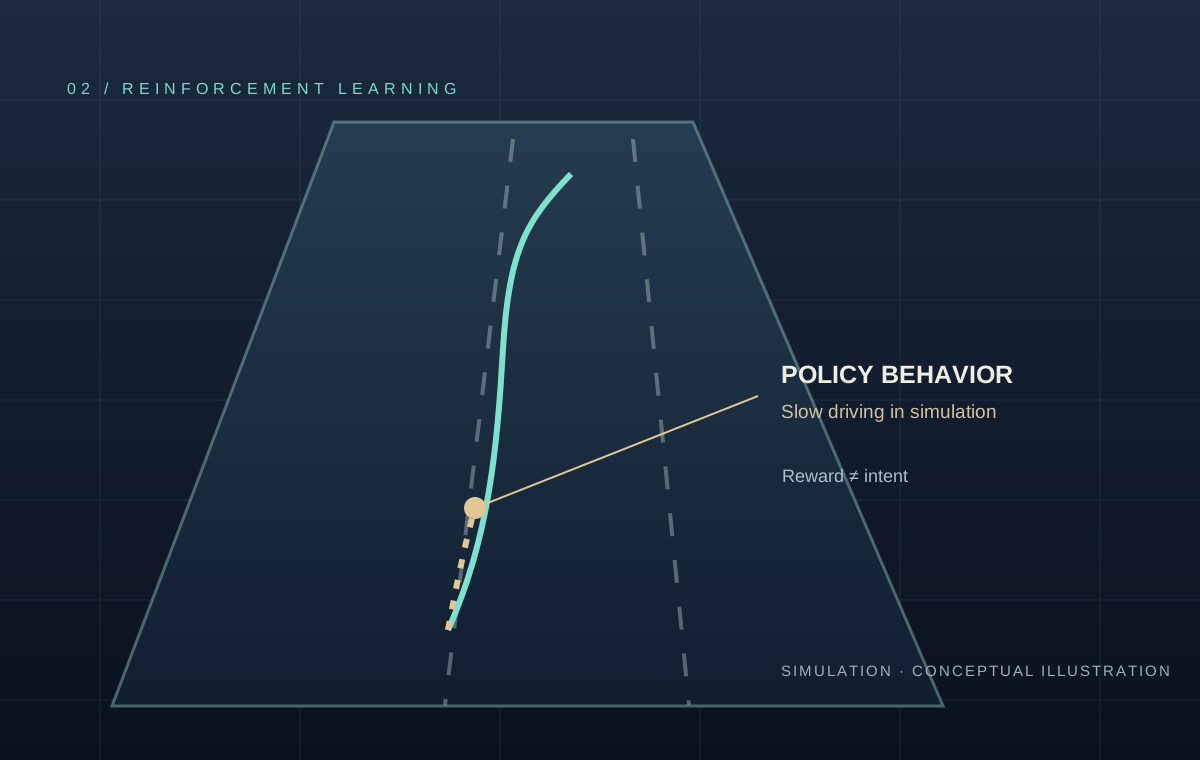
The documented highway policy favored slowing down and avoided acceleration and lane changes in the reported action analysis. Longer survival therefore did not demonstrate the intended combination of speed and collision avoidance.
Evaluation and checkpoints
The repository compares training checkpoints and examines action choices alongside collision outcomes. Its README contains conflicting numerical summaries, so this case study omits crash-rate percentages and survival multipliers until the underlying records are reconciled. Survival alone does not describe whether the policy achieved the intended driving behavior.
Proposed changes
The repository discusses changes to reward terms and training behavior. These are proposed follow-ups, not evidence that the unintended policy was corrected.
Scope and limitations
This is a simulated reinforcement-learning experiment, not a real-world driving system. Low collision counts, long survival and high accumulated reward are not interchangeable measures of successful behavior.
The reported policy behavior is specific to the documented environment, reward setup and evaluation. It should not be treated as proof of a globally optimal policy.
Inspect the work
Cite this work
Obada Alsehli··2026
@project{alsehli2026highwayrlagentpp,
  author       = {Alsehli, Obada},
  title        = {{Highway RL Agent: PPO and Unintended Slow-Driving Behavior}},
  year         = {2026},
  howpublished = {\url{https://obadaalsehli.com/work/highway-rl-agent}}
}
Academic attribution & reproducible reference format
BIBTEX