What I've Built
Production systems, research projects, and infrastructure — all built, deployed, and maintained by me.
Government Performance Index Platform — National Cybersecurity Assessment
National Information Technology Services (NITS)
Cybersecurity assessment platform for government entities. Sole backend engineer on the GPI platform.
- ▸Cybersecurity assessment platform serving 5+ government entities — five-tier RBAC, organization-scoped JWT, and row-level data isolation preventing cross-entity leakage in a shared-database architecture.
- ▸70+ RESTful API endpoints covering survey management, dynamic targeting, automated assignment generation, review workflows, and analytics reporting
- ▸Database performance optimized with indexing strategies, select_related/prefetch_related patterns, and pillar-based scoring aggregation at organization and sector levels
Doc Q&A
Multi-tenant RAG SaaS for document question-answering. Upload documents, ask questions, get AI-powered answers with source citations.
- ▸Multi-tenant RAG SaaS on self-hosted infrastructure — zero cloud cost, per-tenant PostgreSQL schema isolation, document chunking, vector search, and streaming LLM chat with sliding-window history.
- ▸Serverless TypeScript edge functions on self-hosted Supabase (13-container Docker stack on dedicated Ubuntu server)
- ▸Third-party OAuth integration with selective folder sync and real-time sync status dashboard
- ▸Automated tenant provisioning engine for zero-touch onboarding
Fashion Attribute Recognition
Research Project
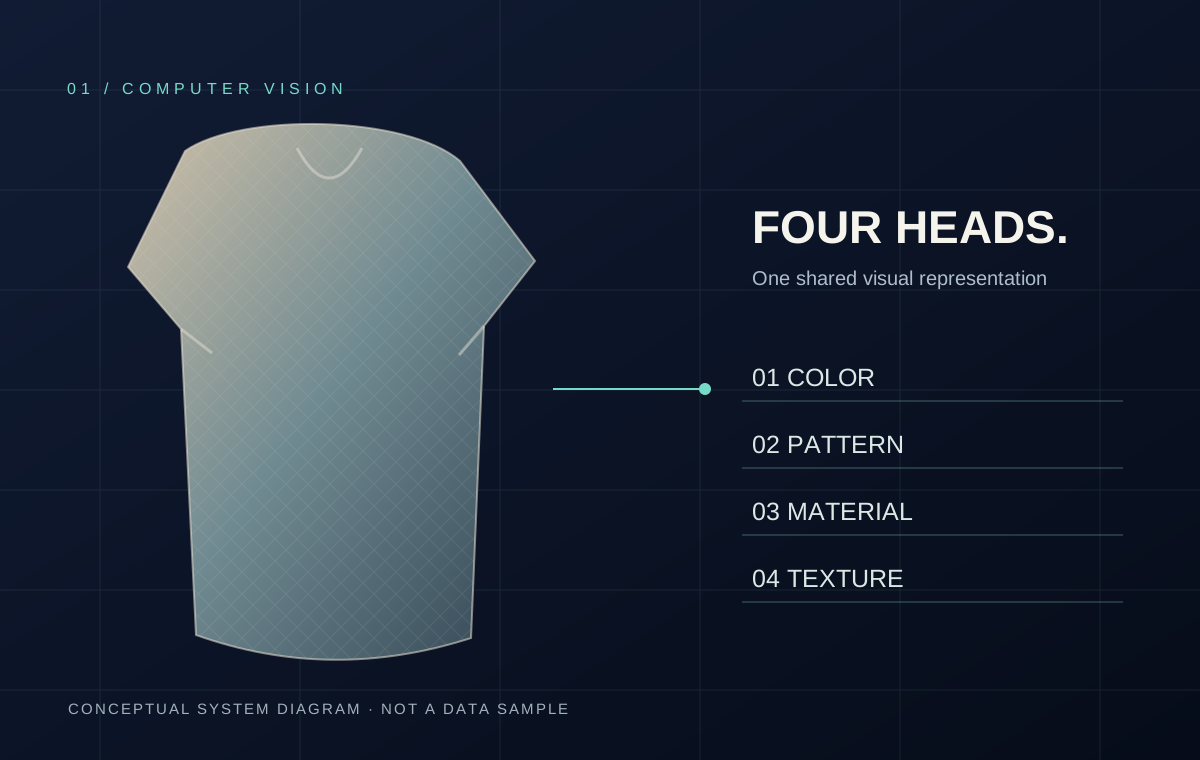
Per-image classification of color, pattern, material, and texture on a 13,355-image TextileNet subset, with a hybrid silver-label pipeline and 210-row human audit anchoring trust per attribute.
- ▸DINOv2 ViT-B/14 fine-tuned on 13,355-image TextileNet subset.
- ▸macro-F1 0.765 across color, pattern, material, texture; +11.6 pp over ResNet-50 baseline.
- ▸210-row manual audit: 0.971 color · 0.803 pattern · 0.681 texture.
- ▸Cramér's V orthogonality check: Δ +0.035.
IDMS — Intelligent Document Management System
Async document management system with vector search, built with production engineering practices.
- ▸Async Python backend with FastAPI, SQLModel, and asyncpg in a 5-service Docker Compose stack (PostgreSQL, Redis, Qdrant, FastAPI, React)
- ▸JWT auth with bcrypt, timing-safe login, RBAC, and PDF upload with magic-byte validation
- ▸Cascading deletion across PostgreSQL, FileStorage, and Qdrant
- ▸20 unit/integration test files (1,499 LOC), 80% test coverage enforced via GitHub Actions CI pipeline
UN1290 — Self-Hosted Production Infrastructure
Self-hosted production infrastructure on a Minisforum UN1290 (i9-12900HK, 32GB RAM) running all project backends and services at $0/month cloud cost.
- ▸13-container self-hosted Supabase stack plus PostgreSQL, Redis, Ollama (local LLM inference), and project APIs — all Dockerized on a dedicated Ubuntu server
- ▸Zero-trust networking: SSH key-only auth, fail2ban, UFW firewall, all services bound to localhost, WireGuard VPN for remote admin, zero exposed ports to public internet
- ▸Multi-machine workflow — IdeaPad (GPU dev) ↔ Tailscale (encrypted tunnel) ↔ UN1290 (services) ↔ Cloudflare Tunnel (public HTTPS at $0)
- ▸Automated PostgreSQL backups with 7-day retention via cron, systemd service management, and tmux-based session management
Research & Experiments
Explorations outside the main backend/infrastructure thesis.
Pose Estimation Research
- ▸Benchmarked MediaPipe (33 keypoints) vs YOLOv8-Pose (17 keypoints) on latency, accuracy, and model size for real-time exercise tracking.
- ▸Shipped the live Squat Counter API with MediaPipe Pose Landmarker only; YOLOv8-Pose stayed in the research comparison.
- ▸Rep counting algorithm using Savitzky-Golay signal filtering and scipy peak detection on joint angle time series extracted from 33 body landmarks
- ▸Video processing pipeline with per-rep form metrics under identical test conditions.
Autonomous Driving RL Agent
- ▸Achieved 97% crash rate reduction (98% → 3%) and 18× survival time increase over 200k training steps using Proximal Policy Optimization (PPO) with CUDA-accelerated training on RTX 3050
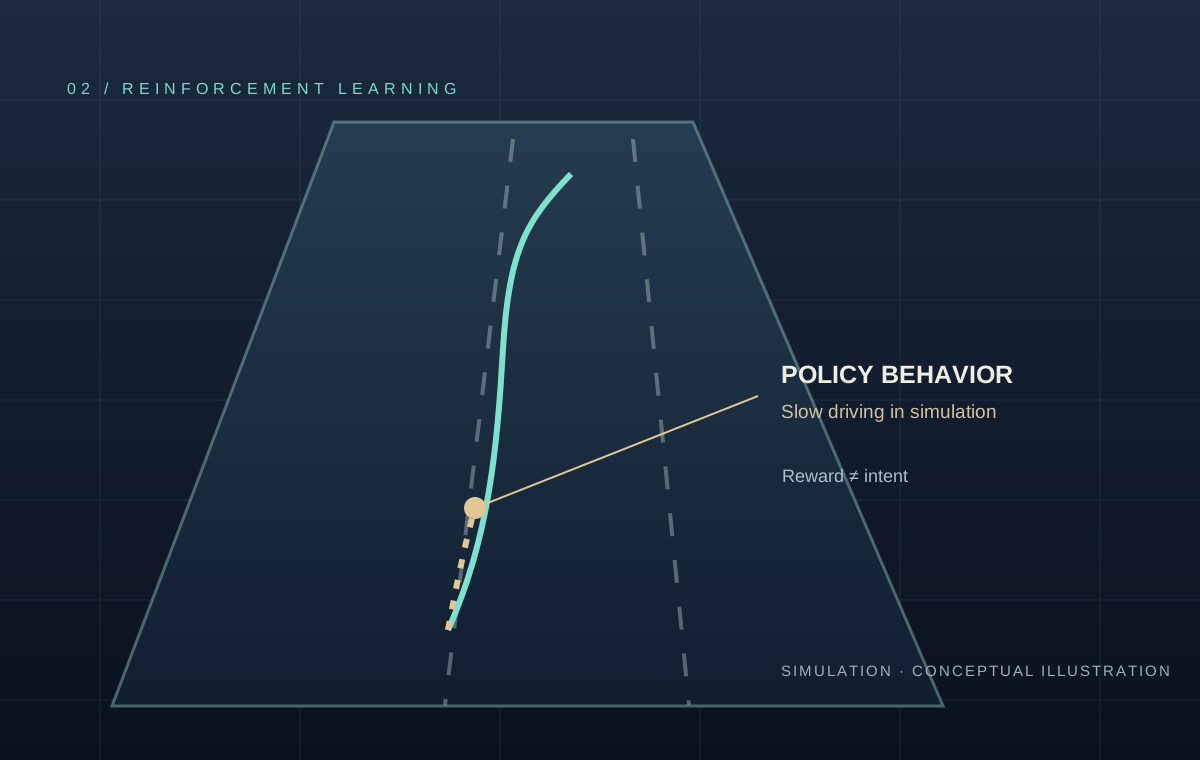
- ▸Designed multi-objective reward function (V6) balancing speed, safety, lane discipline, and collision avoidance — then diagnosed a degenerate slow-driving policy through mathematical break-even analysis proving slow driving was optimal under the reward structure
- ▸Trained across two environments — Highway-v0 (dense 4-lane traffic) and Intersection-v1 (cross-traffic navigation with goal-directed behavior) — discovering overfitting where 100k checkpoint outperformed 200k
- ▸Proposed 4 concrete reward fixes (amplified collision penalty, non-linear speed reward, distance-based reward, stronger speed penalty) with mathematical justification for each